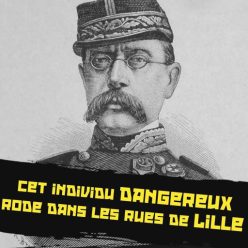

A young, unspectacular man from Lille
Nothing at first destined Faidherbe for a bright future. Born in Lille on 3 June 1818, Louis Léon César Faidherbe, a son of the local petty bourgeoisie, had great difficulty in being noticed in his youth. At the college in Lille, his teachers found him ‘affectionate’ and ‘helpful’, but they had great difficulty in spotting any other qualities in this ‘poorly attended’ and ‘undemanding’ boy. It was only thanks to the benevolence of one of his mathematics teachers that he obtained, through a ploy, a half-scholarship to enter the Ecole Polytechnique in 1838. “One smiles a little when one reads in the directory of the Nord department that Faidherbe entered Polytechnique “thanks to hard work…”, laughs his biographer Alain Coursier, who is nevertheless very complacent.
The rest is no better. He was integrated into the engineering school in Metz (1840) and then appointed to Arras (1842), where he received salty appraisals. “His behaviour was quite correct but he was very dissipated”, commented one of his superiors. “His work is mediocre and incomplete”, added another. No doubt in a hurry to get rid of such an element, his bosses asked for his transfer to Africa. And that was good timing, because, mediocre as he was, Faidherbe dreamed of exotic glories and epic adventures for himself.
A little soldier in the conquest of Algeria
In 1844, Louis Léon was sent to Algeria, where there had been a struggle for some time to impose the benefits of civilisation on the natives. Under the leadership of General Bugeaud, the “land of human rights” massacred the Algerians to teach them the virtues of French culture. Faidherbe witnessed this generous bloodshed at first hand: ‘You are seeing a war of extermination and, unfortunately, it is impossible to do it any other way,’ he wrote to his mother in 1844. After many attempts to inspire him with respect for the law of nations, we are reduced to saying: one Arab killed is two less Frenchmen murdered.
As a good soldier, Faidherbe dreamed of participating in this macabre lesson in arithmetic. But his mission as an engineering officer was limited to the construction of roads and fortifications. When I was in Mostaganem, we were fighting in Djemaa; now that I’m in Djemaa, we’re fighting in Mostaganem,” he notes bitterly. I have to admit that I’m unhappy.
After a short stay in Guadeloupe, Faidherbe was again posted to Algeria in 1849. Having missed out on glory the first time around, Faidherbe was determined to seize this new opportunity.
See: Faidherbe: a ‘negrophile’ in Guadeloupe?
During his second stay in Algeria (1849-1852), he zealously participated in the ‘pacification’ campaign and learned the ‘Bugeaud method’ (looting, massacres, smokeings, destruction of villages, beheading of rebels, etc.). During the expedition to Little Kabylia, in which he took part in 1851 under the orders of the bloodthirsty General de Saint-Arnaud, he sent his mother a satisfied letter: “I have destroyed a charming village of two hundred houses and all the gardens from top to bottom. This terrified the tribe that came to surrender today’ (30 June 1851).
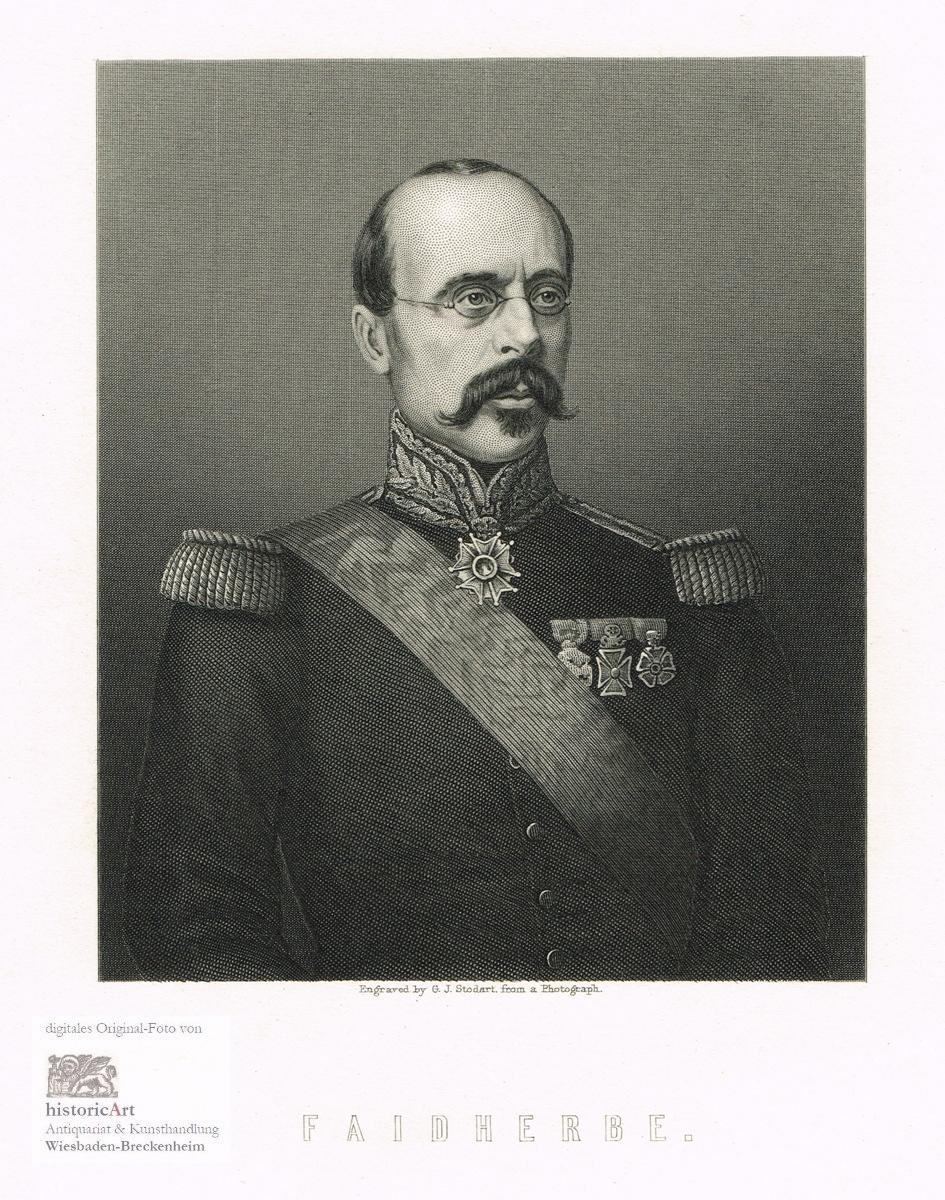
This enthusiastic participation in the influence of France overseas earned Faidherbe, for the first time in his career, the encouragement of his superiors. Saint-Arnaud proposed him for the Legion of Honour – which he did not obtain. However, a misadventure earned him the recognition of his chiefs: caught in a snowstorm during a reconnaissance mission in the Djurdjura mountains, Faidherbe slipped into a torrent of icy water. He narrowly escaped, but was finally awarded the Legion of Honour. However, he suffered the consequences of this faux-pas for the rest of his life: the man depicted in statues in virile postures was in fact diminished by innumerable health problems throughout his life. Arthritis left him paralysed at the age of 57.
The factotum of the businessmen
Assigned to Senegal, Faidherbe disembarked at Gorée on 6 November 1852. It was there that he finally made a name for himself. Initially a simple “assistant director of engineering”, he experienced a meteoric rise: he was appointed governor of the colony only two years after his arrival.
As the historian Leland C. Barrows has shown, this unexpected promotion was the work of a handful of local businessmen, and in particular of the Bordeaux trading house Maurel et Prom, which was established in Senegal and very well connected to Parisian political circles.
Senegal was then only a collection of trading posts. Seeing their profits melt away, following the abolition of slavery and the erosion of gum prices, the French traders were looking for a strong man capable of subduing the surrounding African states, which had the annoying habit of taxing goods and disrupting navigation on the Senegal River. A mania that was all the more detestable because at that time they were trying to plant a promising crop: groundnuts.
The little officer from Lille quickly caught the eye of his future sponsors. In March 1853, he wrote a very favourable report on the trading companies established on the Senegalese coast. From May to November 1853, he took part in an expedition along the Atlantic coast which led him to take part in military operations to defend French commercial interests. And when Faidherbe took part, in March 1854, in the battle of Dialmath (near Podor) to defend – once again – French traders against the local population, Maurel et Prom actively lobbied to propel him to the head of the colony.
Appointed governor of Senegal in December 1854, Faidherbe never forgot those who had supported him: he worked hand in hand with the colonial employers all his life.
The “peacemaker” of Senegal
With the support of the colonialists, Faidherbe began a vast undertaking to “pacify” Senegal as soon as he was appointed, scrupulously applying the ferocious “Bugeaud method”. The aim was to promote trade on the Senegal River by subjugating the neighbouring African states. It was a question, in his words, of becoming the “suzerains of the river”.
Faidherbe’s governorship (1854-1861 and 1863-1865) was marked by an uninterrupted series of military campaigns, from Fouta Toro to Khasso and from Kayor to Casamance (see box). “Before being a “builder”, notes historian Vincent Joly, Faidherbe was first and foremost a destroyer. For years, the people of the region were subjected to French machine gun fire. Men were massacred. Villages were reduced to ashes. Famine, skilfully maintained in the “rebel zones”, became a weapon of war.

As a personal participant in the operations, Faidherbe would claim responsibility for this policy of terror throughout his life. “In ten days, we had burnt several villages along the Taouey, taken 2,000 oxen, 30 horses, 50 donkeys and a large number of sheep, taken 150 prisoners, killed 100 men, burnt 25 villages and inspired a salutary terror in these populations”, he wrote one day. “Nothing can give an idea of the terror that our pursuit inspired in these unfortunate populations, dragged into this war by a few chiefs who had sold out to the Moors,” he added. “If a pillage is committed by the inhabitants of a village, the whole country to which the village belongs is responsible and must expect any kind of reprisal on our part,” he comments. These terror campaigns claim countless victims.
See: Faidherbe’s bloody military expeditions to Senegal (1855-1864)
Seeing himself as the Bugeaud of Senegal, Faidherbe demanded that the soldiers sent to Senegal had Algerian experience. For it was in Algeria, he explained in January 1856, that they learnt ‘how to dominate and organise barbaric peoples and how to wage war together in Algeria and Senegal’.
A technician of colonialism
Faidherbe did not only massacre the Senegalese: he worked hard to control them and make them walk straight. As a good specialist in military engineering, he had all sorts of infrastructures built to cover the territory and extract its wealth. For this reason, he is described by his zealous biographers as a ‘builder’.
He also manoeuvred carefully to win over the natives who could be useful to French supremacy. It is necessary, he wrote from the height of his greatness, ‘to give, when we please, some proof of our munificence to the chiefs with whom we are pleased’. He therefore offered a few favours to the most devoted African chiefs, to whom he subcontracted the daily repression, while at the same time stirring up rivalries between the ‘races’ that populated this territory. Divide and conquer: an old imperial technique.
To make up for the lack of manpower, Faidherbe looked for intermediaries in the local population to ‘defend’ and ‘develop’ the subjugated territories. To do this, he relied on the two main institutions of all authority: the school and the army.
In 1856, he created the “hostage school”, the idea of which was simple: as a token of peace, the submissive chiefs had to leave some of their children in the care of the French administration, which was responsible for making them docile subordinates. In 1857, he set up a new army corps inspired by the indigenous Tirailleurs of Algeria: the “Senegalese Tirailleurs”. Blacks make good soldiers,” wrote Faidherbe in 1859, “because they do not appreciate danger and have a very poorly developed nervous system. In the following decades, the Senegalese riflemen would serve to defend France’s interests on all battlefields (and would later feed the colonial imagination thanks to the chocolate smile of the friendly ‘Banania’ rifleman).

Faidherbe resolutely invested in the teaching of French, in order to anchor in young African minds the subtleties of the language of Molière and thus help them to discover the eternal genius of France, ‘this old and noble nation which has walked for centuries at the head of the civilisation of the world’ (as he described it in 1855). Such altruism was, however, accompanied by a more immediate aim: to distance Africans from traditional local institutions, which the colonial administration was also trying to control.
In particular, Faidherbe had an ambiguous relationship with Islam. While he obviously hated this ‘half-civilisation’, as he called it, which jeopardised France’s generous efforts in Senegal, he saw Muslim institutions as a potential tool for enforcing order and ensuring the unity of the colony. As one observer notes, Faidherbe saw Islam as ‘a stage between African barbarism and the final acclimatisation of European influence’.
A racist ideologue
If Faidherbe still enjoys a reputation today as a ‘negrophile’ and ‘Islamophile’, it is because his racism was more sophisticated than that of his contemporaries and that he succeeded in giving it a ‘scientific’ character. Aware that knowledge is necessary to subdue, Faidherbe studied in detail the peoples he intended to dominate.

As soon as he arrived in Senegal, he contacted the learned societies in Paris and took part in the effort to classify the local peoples. Unlike his predecessors, who were content with descriptions and typologies, Faidherbe set out to establish a coherent and hierarchical raciological system. He thus describes the history of Senegal as an endless “war of the races”.
This analysis naturally leads to the magnification of the colonial gesture which, after having divided ‘the Africans’ into two camps, entrusts the Whites with the mission of protecting the most fragile (the good guys) against the others (the bad guys). The former have the particularity of having black skin, says Faidherbe, and a singularly narrow brain. “The inferiority of the blacks is undoubtedly due to the relatively small size of their brains,” he noted in 1879. The latter, with their lighter complexion, are congenitally inclined to physical violence and the most fanatical Mohammedanism. By carrot or stick, all these people are summoned to submit to the white master.
In contrast to those who advocate the pure and simple extermination of ‘backward’ peoples, Faidherbe is one of the optimists. If the inferior races were undoubtedly doomed to disappear, he thought, there was no need to put them to the sword. As a humanist, he recommended cross-breeding, the pleasures of which he himself appreciated.
See: Faidherbe adept at ‘métissage
According to Faidherbe’s conception, mixed-breeders benefit from the respective qualities of the ‘races’ that produced them (i.e. the superior intelligence of whites and the physical robustness of blacks). In addition to providing the intermediaries indispensable to colonial administration, this theory allowed the governor to present French colonisation in a humanitarian light: perhaps it could regenerate the decaying ‘races’ and offer hope to the Blacks whom the implacable laws of natural history had condemned?
An icon of the colonial republic
Although his military ‘exploits’ proved largely useless during the 1870 war – Prussia crushed France to the ground – Faidherbe, made a general by the Second Empire in 1863, immediately became an icon of the Third Republic. Born of the debacle, the Third Republic sought patriotic symbols. It elevated Faidherbe to the rank of national hero. Did he not fight valiantly against the German enemy? Did he not bring our universal enlightenment to our African friends?
Deputy of the North in 1871, senator in 1879, Faidherbe enjoyed a happy retirement, during which he cured his arthritis and pampered the retrospective legend of his life. A member of many learned societies, he shared his racist theories widely, defended the colonial conquest undertaken by the young Republic, and gave advice to the soldiers who set out to civilise the interior of Africa and to the businessmen who offered to assist them.

Faidherbe died on September 28, 1889, surrounded by glory. Republicans of all persuasions fought over his legacy. A great defender of the civilising mission of the “superior races”, Jules Ferry wrote this moving tribute to his widow: “I studied his African work […] and fought with all my strength to ensure that this great undertaking was energetically continued.
Lille and its region were also in tears. Thousands of people attended his funeral. The city authorities named the station street after him and a national subscription was launched to erect a statue of him. When the statue was finally unveiled in 1896, grateful patriots poured out their exalted praises. By the unity of his life, the uprightness of his character, his private qualities, his valour and his devotion to the fatherland, he almost touches true greatness,” wrote the editorialist of the Petit Parisien. There is not a task, not a failure, not a contradiction in this existence. Three supreme affections have woven and filled it: the family, science, the fatherland; I should add: humanity.”